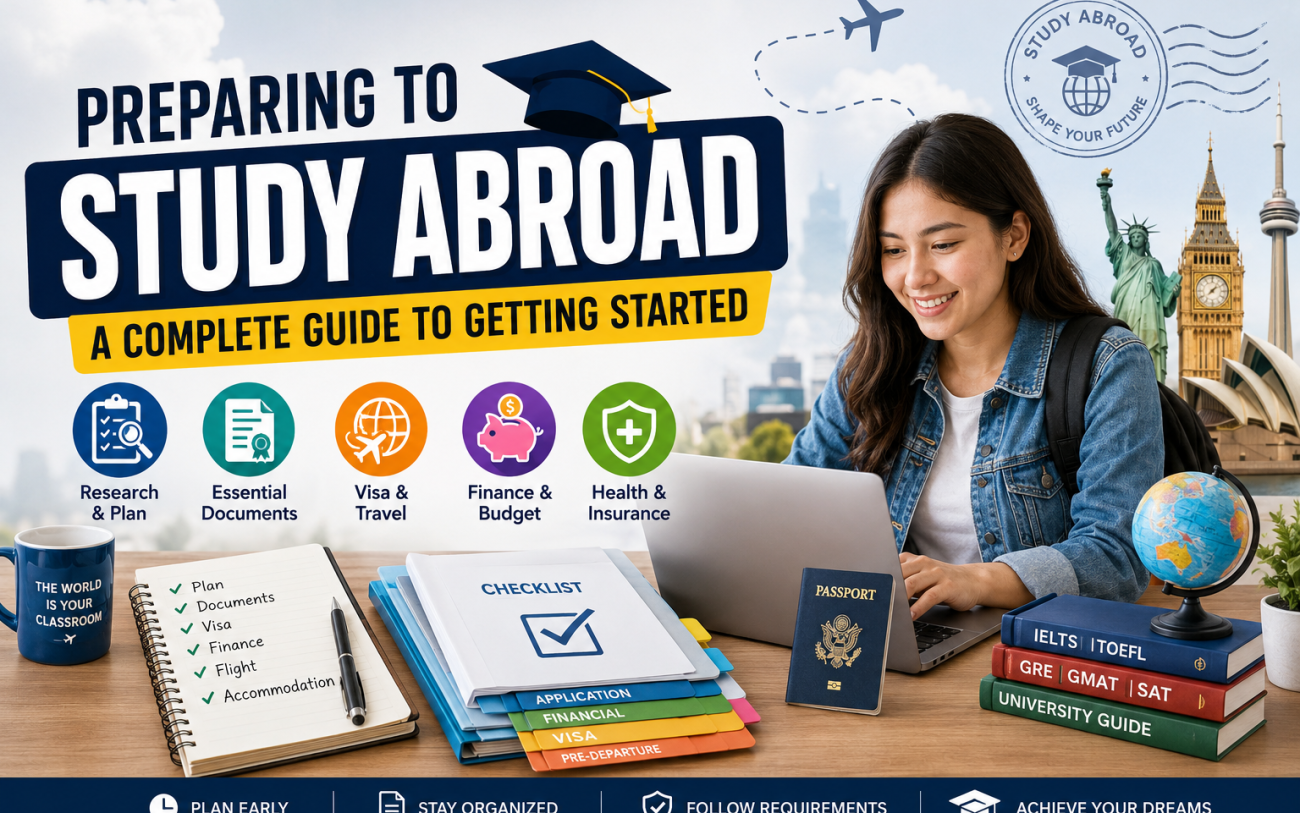
Preparing to Study Abroad: A Complete Guide to Getting Started
Studying abroad is one of the most exciting decisions a student can make — but it’s also one of the most paperwork-heavy. Long before you board a flight, there’s a process of research, planning, testing, and document collection that can take anywhere from six months to over a year. This guide walks you through everything you need to prepare, step by step, so nothing catches you off guard.
1. Start With Self-Assessment and Research
Before touching a single form, get clear on the basics:
- Why are you going abroad? Better academic reputation, career opportunities, specific course offerings, or a desire for international exposure — your reason shapes everything else.
- Which countries and universities fit your goals? Compare tuition costs, living expenses, course curriculum, faculty, campus life, post-study work options, and visa policies.
- What’s your budget? Include tuition, accommodation, travel, insurance, and daily living costs, and check what financial proof the destination country will require.
A shortlist of 3–5 universities across 1–2 countries is a realistic starting point.
2. Understand the Timeline
Most study-abroad journeys follow a rough timeline:
| Time Before Intake | What to Do |
|---|---|
| 12–18 months | Research countries/universities, start test prep |
| 10–12 months | Take standardized tests (IELTS/TOEFL, GRE/GMAT/SAT) |
| 8–10 months | Shortlist universities, prepare SOP, request recommendation letters |
| 6–8 months | Submit applications |
| 3–5 months | Receive offers, apply for visa, arrange finances |
| 1–2 months | Book flights, accommodation, attend pre-departure briefings |
Deadlines vary widely by country and intake (Fall, Spring, Winter), so always confirm exact dates on the university’s official website.
3. Standardized Tests You May Need
Depending on your destination and course, you’ll likely need one or more of the following:
- English proficiency tests: IELTS, TOEFL, PTE Academic, or Duolingo English Test (required for most English-speaking countries unless you’re from an English-medium education background).
- Graduate admission tests: GRE (general graduate programs), GMAT (business/MBA programs).
- Undergraduate admission tests: SAT or ACT (mainly for the US).
- Country-specific requirements: TestDaF or Goethe-Zertifikat for Germany, DELF/DALF for France, etc.
Register for these early — test slots fill up quickly, and scores can take a few weeks to arrive.
4. Core Documents Checklist
This is where most students get overwhelmed. Here’s a comprehensive breakdown of documents you’ll typically need, organized by stage.
A. Documents for University Application
- Academic transcripts and mark sheets (from high school and/or undergraduate degree, often needing official translation and attestation)
- Degree certificates / provisional certificates
- Statement of Purpose (SOP) explaining your academic background, career goals, and why you chose that program/university
- Letters of Recommendation (LORs) — usually 2–3, from professors or employers
- Updated resume/CV
- Standardized test score reports (IELTS/TOEFL, GRE/GMAT/SAT as applicable)
- Portfolio (for art, architecture, design, or similar creative courses)
- Passport-size photographs (as per specific university format)
- Valid passport copy
B. Financial Documents
- Bank statements (usually last 3–6 months, showing sufficient funds)
- Proof of scholarship or education loan sanction letter, if applicable
- Affidavit of financial support from parents/sponsors, if funds are not in the student’s own name
- Fixed deposit receipts or income tax returns of sponsors (some countries require this)
- Fee payment receipts once the offer is accepted
C. Visa Application Documents
Once you receive your university offer letter, the visa process begins. Always apply through your destination country’s official government portal — never a third-party site claiming to process visas on your behalf. Key official portals:
- United States (F-1 visa): travel.state.gov – Student Visa
- United Kingdom (Student visa): gov.uk/student-visa
- Canada (Study Permit): canada.ca – Study in Canada
- Australia (Student visa, subclass 500): studyaustralia.gov.au and immi.homeaffairs.gov.au – Visa Finder
- Germany: DAAD – Deutscher Akademischer Austauschdienst
Common requirements include:
- Letter of acceptance / I-20 (for the US) / CAS (for the UK) or equivalent enrollment confirmation from the university
- Valid passport (with at least 6 months validity beyond your intended stay)
- Visa application form, filled and signed
- Proof of funds (as above)
- Medical examination certificate / health check reports (required by countries like the UK, Australia, New Zealand)
- Police clearance certificate, in some cases
- Visa fee payment receipt
- Passport-size photographs matching visa photo specifications
- Statement of Purpose for visa (separate from your university SOP in many cases)
- Proof of accommodation (hostel booking, rental agreement, or university housing confirmation)
- Travel/health insurance covering the study period
D. Pre-Departure Documents
- Flight tickets
- Accommodation confirmation
- Health/travel insurance policy documents
- International student ID card, if applicable
- Local currency / forex card
- Copies of all key documents (keep both physical and scanned copies, and share copies with family)
- Emergency contact list including the university’s international student office
5. Financial Planning
Beyond arranging tuition fees, plan for:
- Cost of living in your destination city (rent, food, transport, utilities)
- Currency exchange and international bank accounts — some banks offer student-friendly accounts with lower international transfer fees
- Education loans, if needed — start this process early since loan approval and disbursement can take weeks
- Scholarships and grants — many are merit-based and have their own separate deadlines and documentation
6. Health and Insurance
- Get a full medical check-up and any vaccinations required by your destination country.
- Arrange health insurance — some countries mandate specific insurance providers or minimum coverage amounts.
- Carry a copy of your medical history and any ongoing prescriptions, along with a doctor’s note if carrying medication internationally.
7. Accommodation and Logistics
- Decide between university dormitories, private student housing, or homestays.
- Book accommodation only through verified university housing portals or trusted platforms — scams targeting international students are common.
- Research local transport, SIM cards, and banking options you’ll need in your first week.
8. Common Mistakes to Avoid
- Waiting too long to book English tests or standardized exams — slots and score processing take time.
- Submitting incomplete or unattested documents — many countries require notarization or apostille on academic documents.
- Underestimating visa processing times — some visas take 8–12 weeks or longer.
- Not keeping digital backups of every document.
- Ignoring the fine print on insurance and financial proof requirements — these vary a lot by country and change periodically.
Final Checklist Before You Leave
- University offer letter accepted and fees paid
- Visa approved and stamped
- Flight booked
- Accommodation confirmed
- Health insurance active
- All original and scanned documents organized
- Local currency/forex card arranged
- Pre-departure briefing attended (many universities and consulates offer these)
Conclusion
Studying abroad is a rewarding but document-intensive journey. The key to a smooth process is starting early, keeping a checklist for each stage — application, financial, visa, and pre-departure — and double-checking every requirement against your specific university and country’s official guidelines, since rules can change from year to year. With careful planning, the paperwork becomes manageable, leaving you free to focus on the excitement of the journey ahead.