PR After Studies: 7 Best European Countries
Studying in Europe is one thing. Staying for good is another.
Fortunately, several European countries have a clear path from student visa to job to permanent residency (PR). No investment is needed, and no decades of waiting either.
So here’s a fast breakdown of the best options in 2026.
Quick Comparison
| Country | Post-Study Stay | PR Timeline |
|---|---|---|
| Germany | 18 months to find a job | As fast as 21 months for skilled workers |
| Ireland | 2 years | Around 5 years total |
| Netherlands | 1-year orientation year | Varies with Blue Card/HSM route |
| Portugal | Job-seeker visa | 5 years |
| Finland | Job-search residence permit | Around 4 years |
| France | 1-year (APS) | Varies by permit type |
| Sweden | Post-study work permit | Around 4 years |
1. Germany — Fastest, Most Popular
International graduates get an 18-month visa in Germany just to find a job. Once hired, the next step is a work visa or the EU Blue Card.
Here’s the big win: skilled workers who meet salary and language requirements can qualify for PR in as little as 21 months. For everyone else, it usually takes 5 years instead.
Best for: engineering, IT, healthcare, and skilled trades.
2. Ireland — Straight Line to Tech Jobs
Postgrads in Ireland get a 2-year stay-back window, with easy access to the global tech and pharma companies based there.
Once a Critical Skills or General Employment Permit is secured, long-term residence typically follows after about 5 years.
Best for: IT, pharma, finance, and business.
3. Netherlands — The Orientation Year Advantage
A full 1-year “orientation year” lets graduates search for work without needing a separate permit. After that, most move onto the Highly Skilled Migrant visa or an EU Blue Card.
That said, PR in the Netherlands requires passing a civic integration exam, including Dutch at A2 level (possibly B1 soon). Because of this, it’s worth starting language study early.
Best for: business, tech, and engineering — especially in Amsterdam, Rotterdam, and Eindhoven.
4. Portugal — Softer Landing, EU-Wide Mobility
There’s a reason Portugal is so popular: lower cost of living, relatively accessible rules, and a real path to citizenship.
Once PR is held for 5 years, applying for Portuguese citizenship becomes possible — meaning the right to live, work, and study anywhere in the EU.
Best for: anyone wanting a lower-stress transition plus long-term EU flexibility.
5. Finland — Underrated Option
Finland actively wants to keep hold of its international graduates. To make that happen, a residence permit is issued to job-hunt after finishing studies. Once employment kicks in, PR is typically about 4 years away.
Best for: tech, forestry, clean energy, and applied sciences.
6. France — Post-Study Permit Plus Entrepreneur Routes
Under the APS permit, graduates can stay and work in France for a year after a master’s, with the option to extend once employed. On top of that, there’s a business-creator visa and the Talent Passport for skilled professionals — both leading to longer-term residence.
Best for: business, engineering, design, and future founders.
7. Sweden — Strong Worker Rights
A post-study work permit is the starting point in Sweden, with PR usually following about 4 years of continuous, legal work. Meanwhile, Sweden is also known for strong family reunification rights.
Best for: engineering, life sciences, and sustainability.
Does a Post-Study Visa Automatically Give You PR?
No — and this trips a lot of people up.
Essentially, a post-study visa just buys time to find a job. Only after that does PR come into play, once these steps are completed:
- Finish studies and activate the job-search permit
- Land a qualifying skilled job
- Switch to a proper work visa (Blue Card, Skilled Worker, Talent Passport, etc.)
- Build up the required years of legal residence
- Apply for PR, and later citizenship if desired
What Actually Affects Your PR Timeline
- Language skills — Germany and the Netherlands reward this with faster timelines
- Field of study — STEM, healthcare, and IT graduates usually move faster
- Salary — Blue Card and skilled-worker routes have minimum thresholds
- Visa gaps — even a short lapse can reset the PR clock
- Local integration steps — civic exams, interviews, and cultural requirements
So, Which Country Should You Pick?
- For speed, Germany or the Netherlands are the strongest picks.
- For an easier transition, Portugal is worth serious consideration.
- For a global tech career, Ireland is hard to beat.
Either way, getting the university choice, visa paperwork, and finances right the first time saves months of stress later on.
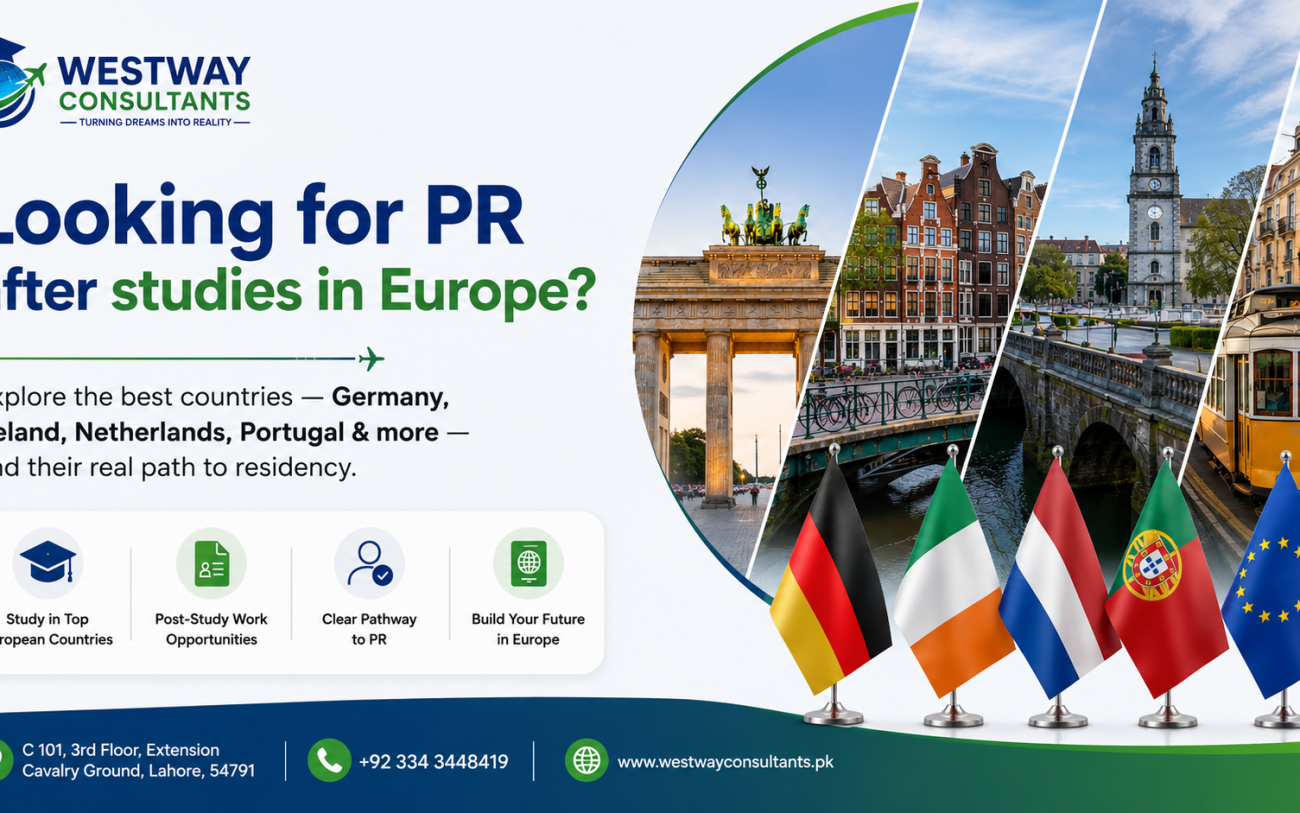
Need help picking the right country and planning your PR path? Westway Consultants helps Pakistani students choose the right European destination and guides them through the entire visa and post-study process from day one.