
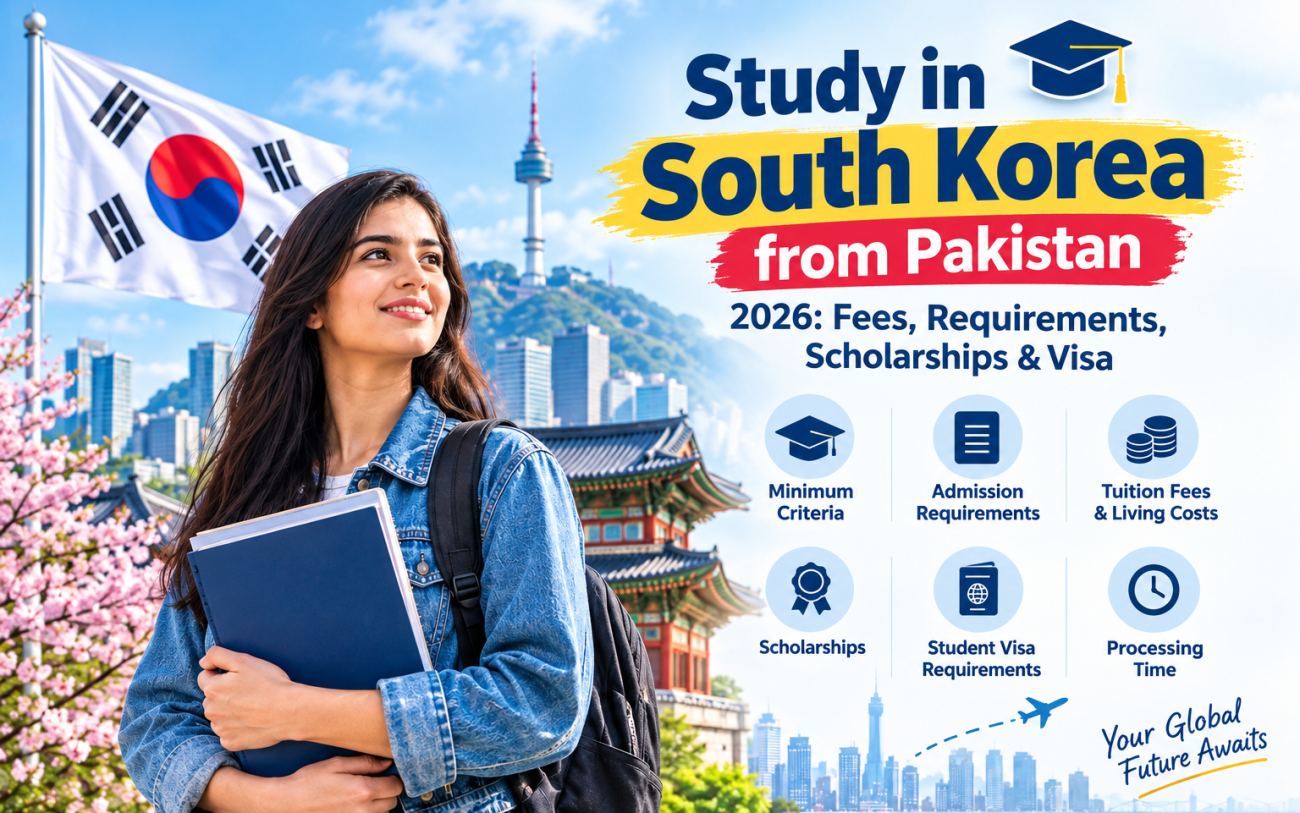
Study in South Korea from Pakistan 2026: Requirements, Fees, Budget, Scholarships & Visa Guide
Study in South Korea from Pakistan 2026: Fees, Requirements, Scholarships & Visa
Study in South Korea from Pakistan is becoming an attractive option for students looking for quality education, modern universities, scholarships, and international career opportunities. South Korea offers bachelor’s, master’s, and doctoral programs in fields such as engineering, computer science, artificial intelligence, business, biotechnology, data science, and other high-demand areas. In this guide, Pakistani students can learn about the minimum criteria, admission requirements, tuition fees, living costs, scholarships, total budget, student visa requirements, and processing time for studying in South Korea in 2026.
South Korea has developed a strong higher-education system and provides international students with access to universities, scholarships, research opportunities, and technology-focused programs. The official Korean government Study in Korea portal allows international students to search for universities, programs and scholarships.
Why Study in South Korea from Pakistan?
South Korea is one of Asia’s leading education and technology destinations. Students can choose from a wide range of programs at universities located in Seoul and other major cities.
Some major advantages include:
- Globally recognized universities
- Strong programs in engineering and technology
- Bachelor’s, master’s and PhD opportunities
- English-taught programs at selected universities
- Government-funded scholarships
- University-specific scholarships
- Modern infrastructure
- Affordable public transportation
- Research opportunities
- Opportunities to learn Korean
- Strong technology and innovation environment
Students interested in computer science, artificial intelligence, engineering, business, biotechnology, data science and research may find particularly strong options in South Korea.
Minimum Criteria to Study in South Korea
There is no single percentage requirement for every Korean university. Admission criteria depend on the university, degree level, program and applicant’s academic background.
The Korean government’s Study in Korea portal states that applicants for regular programs generally need to have completed the previous level of education and meet the individual school’s admission criteria.
Bachelor’s Degree
Pakistani students generally need:
- Completed Intermediate/HSSC or equivalent education
- Academic certificates and transcripts
- A valid passport
- Required language qualification
- Any additional documents required by the university
- Evidence of financial capacity for study and living expenses
The exact percentage or GPA requirement can vary between universities and programs.
Master’s Degree
For a master’s program, students generally need:
- A recognized bachelor’s degree
- Academic transcripts
- Relevant academic background
- English or Korean language qualification where required
- Statement of purpose or study plan
- Recommendation letters where required
- Passport and other supporting documents
The Korean government confirms that applicants entering a master’s degree generally need a bachelor’s degree or equivalent qualification.
PhD
PhD applicants generally need:
- A relevant master’s degree
- Academic transcripts
- Research proposal or study plan
- Recommendation letters
- CV/resume
- Language qualification where required
- Additional research documents requested by the university
For research-intensive programs, your previous academic work and research interests can be particularly important.
Admission Requirements for Pakistani Students
If you plan to study in South Korea from Pakistan, prepare your documents well in advance.
Academic Documents
Depending on your degree level, you may need:
- Matric/SSC certificate
- Intermediate/HSSC certificate
- Bachelor’s degree
- Master’s degree
- Academic transcripts
- Educational document attestations where required
For the Korean student visa, the Korean Embassy in Pakistan currently requires educational certificates/degrees to be attested by HEC or the relevant educational board.
Personal Documents
You may need:
- Valid passport
- Passport photographs
- National identity documents
- Family relationship documents where applicable
- Birth or family certificates where required
Application Documents
Depending on the university and program, applicants may also need:
- Online application
- Statement of purpose
- Study plan
- Recommendation letters
- CV
- Research proposal
- Portfolio for selected programs
- Language certificate
Always check the admission guide of your selected university because requirements can differ.
English and Korean Language Requirements
Language requirements depend on the program.
English-Taught Programs
Many English-medium programs may require proof of English proficiency. IELTS, TOEFL or another accepted qualification may be requested depending on the university.
For Pakistani applicants applying for a D-2 student visa, the Korean Embassy in Pakistan currently lists an official English-language certificate, with IELTS preferred, among the student visa documents.
Korean-Taught Programs
Students applying to Korean-taught programs may need Korean-language proficiency.
The TOPIK test is the standard Korean-language proficiency examination. However, the required level depends on the university and program.
South Korea University Fees 2026
One of the most important questions for students planning to study in South Korea from Pakistan is the cost of tuition.
According to the Korean government’s Study in Korea portal, average annual undergraduate tuition is approximately:
| University Type | Average Annual Tuition |
|---|---|
| National average | ₩6.82 million |
| National & public universities | ₩4.27 million |
| Private universities | ₩7.63 million |
| Metropolitan universities | ₩7.65 million |
| Non-metropolitan universities | ₩6.32 million |
These figures are averages. Actual tuition varies according to university, program and degree.
Tuition by Field
Average annual undergraduate tuition varies by subject:
| Field | Approx. Annual Tuition |
|---|---|
| Humanities & Social Sciences | ₩6.00 million |
| Natural Sciences | ₩6.88 million |
| Engineering | ₩7.28 million |
| Arts & Physical Education | ₩7.83 million |
| Medicine | ₩9.84 million |
Medicine and some specialized programs can therefore cost significantly more than general programs.
For the most accurate fee, students should check the official website of their chosen university before applying.
Cost of Living in South Korea
Tuition is only one part of the overall budget. Students should also consider accommodation, food, transportation, communication, health insurance and personal expenses.
The Korean government’s Study in Korea portal estimates average monthly living expenses at approximately:
₩750,000–₩1,000,000 per month.
A general breakdown is:
| Expense | Estimated Monthly Cost |
|---|---|
| Accommodation | ₩500,000–₩700,000 |
| Food | ₩200,000–₩300,000 |
| Transportation | ₩50,000–₩100,000 |
| Other expenses | ₩100,000–₩200,000 |
Actual expenses depend on the city, accommodation type and lifestyle. Seoul may be more expensive than smaller cities.
Total Budget to Study in South Korea from Pakistan
A realistic budget should include both tuition and living expenses.
Annual Tuition
For many undergraduate programs, national averages range from approximately ₩4.27 million at national/public universities to ₩7.63 million at private universities.
Annual Living Expenses
Based on the government’s monthly estimate, students should plan approximately:
₩9 million–₩12 million per year for living costs.
Additional Costs
Students should also budget for:
- University application fee
- Visa fee
- Airfare
- Document attestation
- Medical/TB testing where required
- Accommodation deposit
- Health insurance
- Books and study materials
- Initial settlement expenses
Important Budget Advice
Avoid advertising one fixed PKR budget because the Korean won-to-PKR exchange rate changes.
Instead, calculate your expected costs in KRW and convert them to PKR using the current exchange rate when preparing the student’s financial plan.
Scholarships for Pakistani Students in South Korea
Scholarships can significantly reduce the cost of studying in South Korea.
International students should explore two main categories:
- Global Korea Scholarship (GKS)
- University scholarships
Global Korea Scholarship (GKS)
The Global Korea Scholarship (GKS) is the Korean government’s major scholarship program for international students.
Depending on the specific GKS program, benefits can include:
- Airfare
- Korean language training
- Tuition support
- Study allowances
- Other scholarship benefits
The Korean government describes GKS as a program designed to attract talented international students and strengthen global educational networks.
GKS is available for undergraduate and graduate-level opportunities, although eligibility requirements vary according to the specific program and year.
GKS Undergraduate Eligibility
For the current GKS undergraduate information published by Study in Korea, applicants generally need to meet nationality requirements, be under 25 for the applicable year and have at least 80% academic performance in their most recent educational program.
GKS Graduate Eligibility
Graduate GKS programs have their own requirements covering nationality, age, degree qualifications and academic performance. Students should always review the latest official GKS announcement before applying.
GKS Application Routes
Students generally apply through:
Embassy Track:
Application through the Korean embassy in the applicant’s country.
University Track:
Application directly to a designated Korean university.
The official Study in Korea portal provides the current GKS application information and participating universities.
University Scholarships in South Korea
Apart from GKS, many Korean universities offer scholarships for international students.
Scholarships can be based on:
- Academic performance
- Previous GPA
- Admission results
- TOPIK results
- English proficiency
- Department recommendation
- Research performance
The Korean government’s Study in Korea portal states that many universities provide scholarships covering approximately 30% to 100% of tuition, depending on academic performance and university policy.
Therefore, students should always check the scholarship section of their selected university before submitting an application.
South Korea Student Visa from Pakistan
Students enrolling in a full-time degree program generally require a D-2 student visa.
The D-2 category includes study at the associate, bachelor’s, master’s and doctoral levels. The Korean government’s Study in Korea portal provides information about D-2 visa categories and student stay periods.
Students taking Korean-language training may fall under a different visa category, such as D-4-1.
South Korea Student Visa Requirements from Pakistan
The Korean Embassy in Pakistan currently lists several requirements for D-2 student visa applicants.
Documents from the Korean University
Students generally need:
- Original admission letter
- Standard admission permit
- University business registration certificate
- Scholarship certificate where applicable
Documents from Pakistan
The embassy currently lists:
- Educational certificates/degrees
- Required attestations
- Official English-language certificate
- Bank statement
- Financial affidavit where applicable
- Scholarship or financial-support letter if applicable
- Medical certificate
- TB test report where applicable
The embassy also states that Pakistani applicants should provide financial evidence covering the relevant study and living costs and specifies requirements concerning six-month bank statements and the period funds must have been held.
Financial documents should be genuine, consistent and properly prepared.
South Korea Student Visa Processing Time from Pakistan
Visa processing time is an important part of planning your application.
The Korean Embassy in Pakistan’s visa announcement dated December 23, 2025 states a minimum processing time of 8 weeks after receiving the application.
The embassy’s general visa-requirements page currently displays a minimum processing time of three weeks, so students should check the latest visa announcement before applying and allow sufficient time for processing.
For this reason, students should not make non-refundable travel arrangements based on the shortest stated processing period.
South Korea Student Visa Fee from Pakistan
Visa fees can change, so applicants should verify the current fee before submission.
The Korean Embassy’s published information for Pakistani nationals should be treated as the primary source for the applicable student visa fee and payment procedure.
For your website, it is better to link directly to the embassy’s latest visa announcement rather than publishing an amount that may become outdated.
How to Apply to Study in South Korea
The process can be divided into several steps.
Step 1: Choose Your Course and University
Research:
- Degree level
- Major
- Tuition fee
- Language of instruction
- Scholarship opportunities
- Location
- Admission requirements
The official Study in Korea portal provides a searchable database of Korean universities and programs.
Step 2: Check Your Eligibility
Review your:
- Academic qualification
- GPA or percentage
- Language proficiency
- Program-specific requirements
- Nationality eligibility
Step 3: Prepare Your Documents
Prepare academic, personal, financial and application documents according to the university’s requirements.
Step 4: Apply for Admission
Submit the application through the university’s official application system and pay the applicable application fee.
Step 5: Receive Your Admission Documents
If your application is successful, the university will issue the relevant admission documentation.
Step 6: Prepare Your Visa File
Organize your:
- Admission letter
- Educational documents
- Financial documents
- Language certificate
- Medical/TB documents where required
- Passport
- Other embassy-required documents
Step 7: Apply for the D-2 Visa
Submit the application according to the latest instructions from the Korean Embassy in Pakistan.
Step 8: Prepare for Departure
After visa approval, arrange:
- Accommodation
- Flight
- University enrollment
- Travel insurance/health arrangements where applicable
- Initial living funds
When Should You Apply to Study in South Korea?
There is no single application deadline for every Korean university.
Universities and programs can have different admission schedules, so students should check the official deadline of their selected institution.
A good approach is to begin preparing several months before the intended intake.
This gives you enough time for:
University selection → Document preparation → Admission → Financial preparation → Visa application → Visa processing → Travel
Starting early is particularly important for students applying for scholarships or programs with competitive admission.
Popular Study Fields in South Korea
South Korea is particularly well known for technology, engineering and research.
Popular fields for international students include:
- Computer Science
- Artificial Intelligence
- Information Technology
- Data Science
- Engineering
- Business Administration
- Biotechnology
- Natural Sciences
- Electronics
- Robotics
- Economics
- International Business
- Korean Studies
Students should select a program according to their academic background and long-term career goals.
Is South Korea Good for Pakistani Students?
South Korea can be a strong choice for Pakistani students who want quality education, modern infrastructure and access to technology-focused programs.
It can be particularly attractive for students who:
- Have a strong academic background
- Want to study technology or engineering
- Are interested in research
- Want to explore scholarships
- Are comfortable adapting to a new culture
- Are willing to learn Korean when necessary
However, students should compare universities based on tuition, living costs, scholarships, program quality, language requirements and visa requirements.
Documents Checklist for Pakistani Students
Before applying to study in South Korea from Pakistan, make sure you have reviewed the following:
- Academic certificates
- Academic transcripts
- Valid passport
- Passport photographs
- English-language certificate where required
- TOPIK certificate where required
- Statement of purpose
- Study plan
- Recommendation letters
- CV/resume
- Research proposal for PhD applicants
- University admission letter
- Scholarship documents if applicable
- Bank statements
- Financial affidavit where required
- Medical certificate
- TB test report where required
- Educational document attestations
Requirements can change, so always verify the final checklist with your university and the Korean Embassy in Pakistan.
Frequently Asked Questions
What is the minimum percentage required to study in South Korea?
There is no universal percentage requirement for every Korean university. Each institution and program can set its own academic criteria. Students should check the admission requirements of their selected university.
Is IELTS required to study in South Korea?
IELTS requirements depend on the university and program. English-taught programs may require IELTS or another accepted English-language qualification. For the D-2 visa in Pakistan, the Korean Embassy currently lists an official English-language certificate and states that IELTS is preferred.
How much does it cost to study in South Korea?
Average annual undergraduate tuition is approximately ₩6.82 million, although national/public universities average about ₩4.27 million and private universities about ₩7.63 million. Actual fees depend on the institution and program.
What is the monthly living cost in South Korea?
The Korean government’s Study in Korea portal estimates average monthly living expenses of approximately ₩750,000–₩1,000,000.
Comment
George Scicluna
September 18, 2026 - 4:27 pmI already caught myself thinking differently after reading this