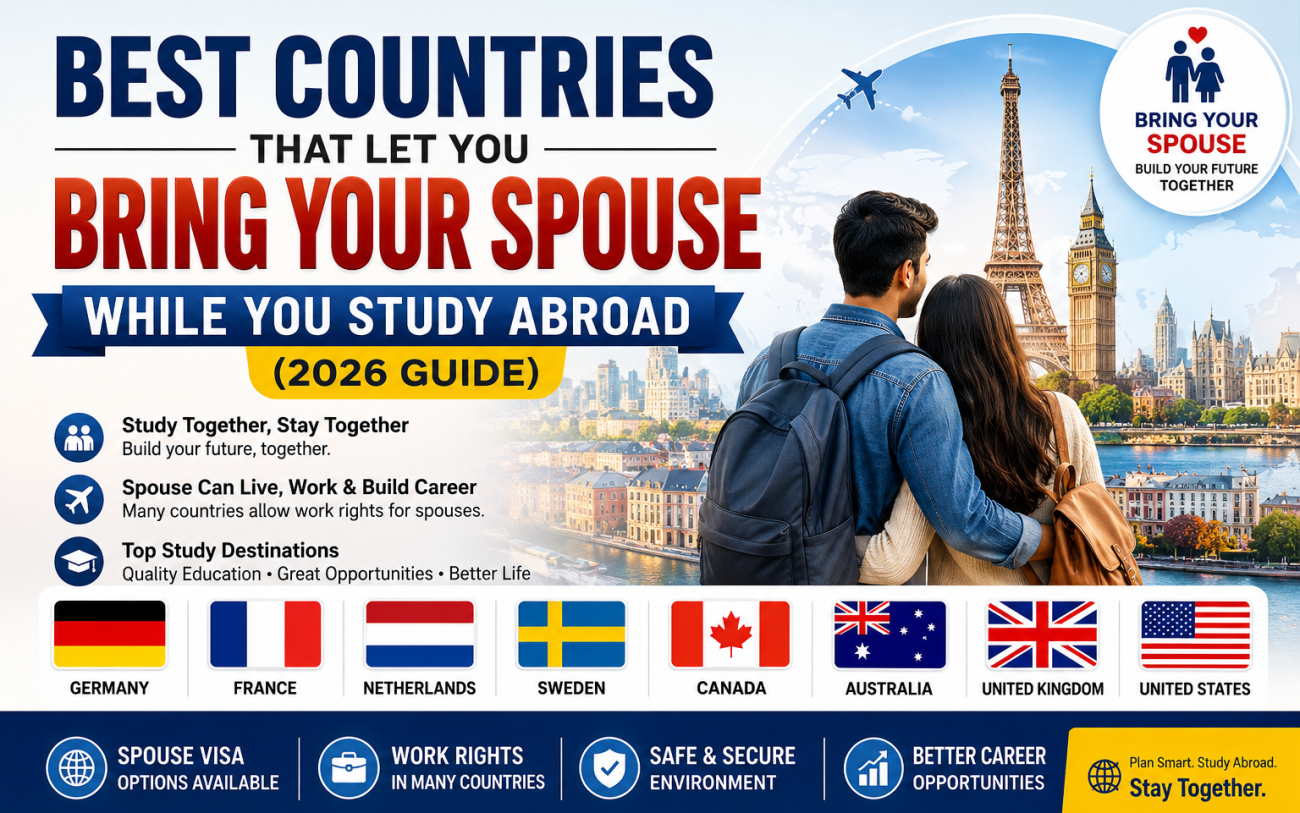
Best Countries That Let You Bring Your Spouse While You Study Abroad (2026 Guide)
Going to study in another country is exciting. But if you are married, one big question comes to mind: “Can my husband or wife come with me?”
The good news is — yes, some countries still let students bring their spouse. The bad news is — the rules changed a lot in 2024, 2025, and 2026. Countries like the UK and Canada, which used to be very easy, are now much stricter. Other countries, like Germany and Australia, are still fairly open.
In this article, we will look at the best countries for students who want to bring their spouse along, in simple, easy English. We will also add official links (backlinks) so you can check the latest rules yourself before you apply.
⚠️ Important note: Immigration rules change often, sometimes every few months. Always double-check the current rules on the country’s official immigration website before making big decisions like buying flights or leaving your job.
Quick Comparison Table
| Country | Can spouse come? | Can spouse work? | Best for |
|---|---|---|---|
| Germany | Yes, fairly easy | Yes, usually full-time | Families, PhD & Master’s students |
| Australia | Yes | Yes, generally full work rights | Couples wanting a strong job market |
| New Zealand | Yes | Yes, full-time | Safety and lifestyle |
| Denmark | Yes | Yes, with conditions | Nordic lifestyle, PhD students |
| Sweden | Yes (mainly for PhD/work visa holders) | Yes | Nordic lifestyle |
| Canada | Only for PhD, long Master’s (16+ months), or select professional programs | Yes, if eligible | Long-term study programs |
| UK | Only for PhD/research students or government-sponsored students | Yes | Research students |
| USA | Yes (F-2 visa) | No work rights normally | Students who don’t need spouse to work |
| Ireland | Limited, case-by-case | Limited | Shorter stays |
Now let’s go country by country in more detail.
1. Germany — Still One of the Friendliest Options
Germany remains one of the most welcoming countries for student couples. If you get a German student visa, your spouse can usually apply for a family reunification visa to join you.
Key points:
- Your spouse can generally work in Germany once they have their residence permit — this is a big advantage compared to countries like the USA.
- You’ll need to show you have enough living space (not just a shared single room) for both of you.
- Your spouse may need to show basic German language ability (usually A1 level) before moving, depending on your specific situation.
- Public university tuition in Germany is free or very low-cost, which helps a lot with the overall cost of moving as a couple.
🔗 Official source: German Missions – Family Reunion Visa
2. Australia — Strong Job Market for Spouses
Australia continues to be a top choice for couples. Spouses (called “secondary applicants”) can often be included in the student visa application itself, or apply for a dependent visa afterward.
Key points:
- Your partner generally gets similar work rights to what you have as a student, and in many cases can work full-time.
- You’ll need proof of marriage or a genuine relationship, proof of enrolment, and proof you can financially support both of you.
- As of 2026, financial requirements are roughly A$29,710 for the student, plus around A$10,394 for a spouse, and about A$4,449 per child, on top of school fees if you have kids.
- Short courses (up to 3 months) may not need a separate student visa for your partner in some cases.
🔗 Official source: Australian Department of Home Affairs – Student Visa
3. New Zealand — Great for Safety and Lifestyle
New Zealand is known for being calm, safe, and family-friendly, and its visa rules reflect that.
Key points:
- Spouses can apply for a “Partner of a Student Work Visa,” which usually allows full-time work in most sectors.
- Partners can often take short courses (up to 3 months) without needing a separate student visa.
- Children of student visa holders can usually attend school, sometimes without paying international student fees, depending on the visa category.
🔗 Official source: Immigration New Zealand – Partner of a Student Work Visa
4. Denmark — A Solid Nordic Option
If you’re heading to Denmark for your studies, your spouse and children can generally apply for a residence permit to join you.
Key points:
- Denmark is especially attractive for PhD students, since PhD candidates in Denmark are often treated more like employees, which can make family visas smoother.
- You’ll need to prove your relationship and show you can support your family financially.
- Denmark’s strong social welfare system is a plus for families settling in for a longer period.
🔗 Official source: New to Denmark – Family Reunification
5. Sweden — Family-Friendly, With Some Limits
Sweden allows dependents to join people who hold valid work or study permits, and it’s known for strong social benefits.
Key points:
- Spouses of work-permit holders generally have an easier path than spouses of regular degree-seeking students.
- Once approved, spouses typically get the right to live, work, and study in Sweden.
- Sweden’s excellent healthcare and social welfare system makes it appealing for young families.
🔗 Official source: Swedish Migration Agency
6. Canada — Still Possible, But Now Much Stricter
Canada used to be one of the easiest countries for bringing a spouse along, but the rules tightened sharply starting in 2024, and again in 2025 and 2026.
As of early 2026, your spouse can only get an open work permit if you are:
- Enrolled in a PhD (doctoral) program, or
- Enrolled in a Master’s program that lasts 16 months or longer, or
- Enrolled in a select professional program (such as law, medicine, engineering, nursing, pharmacy, or education)
Spouses of students in shorter Master’s programs, college diplomas, or undergraduate degrees generally no longer qualify.
There’s one more important update: since March 2026, spouses of students in their final academic term can be refused an open work permit, even when renewing. So timing your spouse’s application matters a lot — don’t wait until your last term to apply or renew.
🔗 Official source: IRCC – Open Work Permits for Spouses
7. United Kingdom — Now Very Restricted
The UK made one of the biggest changes of all. Since January 2024, most international students can no longer bring a spouse or children.
Who can still bring dependants in the UK:
- Students on a PhD, doctorate, or research-based Master’s (RQF level 8) that started after January 1, 2024
- Students on government-sponsored scholarships (like Chevening) for courses lasting 6 months or more
Who cannot bring dependants:
- Undergraduate students
- Taught Master’s students (most standard Master’s degrees)
- Foundation and English language course students
If you’re planning to move to the UK with your spouse, a PhD or a fully-funded scholarship is really your main route now. Financial requirements are also significant — you’ll need to show around £845 per month (London) or £680 per month (outside London) for your dependant, on top of your own funds.
🔗 Official source: UK Government – Student Visa: Family Members
8. United States — Spouse Can Come, But Usually Can’t Work
The USA allows spouses of F-1 (student) visa holders to join on an F-2 dependent visa. However, there’s a major catch.
Key points:
- F-2 spouses generally cannot work in the United States.
- F-2 spouses can sometimes study part-time (recreational or vocational courses), but not full-time degree programs in most cases.
- This makes the US a less attractive choice for couples relying on dual income, but it can still work well for couples who don’t need the spouse to be employed.
- Compare this to H-4 visas (for spouses of H-1B skilled worker visa holders), where work permits are sometimes possible — but that’s a different visa category, not for students.
🔗 Official source: US Department of State – F-2 Visa
9. Ireland — Case-by-Case, More Limited
Ireland is a growing study destination, but bringing a spouse is more limited compared to Australia or Germany. Approval often depends on your specific course length, funding, and immigration officer discretion, so it’s worth checking directly with Irish immigration before planning around it.
🔗 Official source: Irish Immigration Service
What You’ll Usually Need to Apply (No Matter the Country)
Even though every country has different rules, most dependant visa applications ask for similar documents:
- Proof of marriage (marriage certificate) or proof of a long-term relationship
- Proof of your student enrolment (acceptance letter, study permit, or visa)
- Proof of enough money to support both of you (bank statements, sponsorship letters, scholarship proof)
- Sometimes a language test for your spouse (common in Germany and some other countries)
- Health insurance for your spouse
- In some countries, proof you have enough living space for a couple, not just a single room
Simple Tips Before You Apply
- Apply together when possible. In many countries, applying for the spouse’s visa at the same time as the student visa is faster than applying separately later.
- Check the exact course type, not just the degree level. In the UK and Canada especially, a “Master’s” is not automatically enough — the type and length of the program matters a lot now.
- Don’t wait until your final term to renew a spousal work permit (this is now a real risk in Canada).
- Budget for extra costs. Dependant visas usually cost the same as the main student visa, with no family discount, plus health insurance and possibly a health surcharge.
- Talk to the university’s international office. They usually know the latest local rules better than random blog posts (including this one!).
Frequently Asked Questions
Which country is easiest for bringing a spouse while studying? Right now, Germany, Australia, and New Zealand are generally considered more open compared to the UK and Canada, which have both added strict new limits since 2024.
Can my spouse work if they come with me? It depends entirely on the country. Germany, Australia, New Zealand, Canada (for eligible programs), and the UK (for eligible dependants) generally allow spouses to work. The USA is the big exception — F-2 spouses usually cannot work.
Do these rules change often? Yes, very often. Canada and the UK have both changed their rules multiple times just between 2024 and 2026. Always check the official government website (linked above for each country) right before applying.
This article is for general guidance only and is not immigration advice. Rules change frequently — always confirm current requirements with the official immigration authority of your destination country, or a licensed immigration consultant, before making decisions.