From Matric to Full Ride: The Real Way to Study in America for Free (2026 Guide)
So you just finished Matric — and somewhere along the way, someone told you studying in the USA is “too expensive” or “only for rich kids.” Here’s the truth: every single year, thousands of international students with zero financial cushion walk onto U.S. campuses with their tuition, housing, food, and even flight tickets completely covered. Not loans. Not “partial aid.” 100% fully funded scholarships.
If you’ve been searching for how to study in America for free after Matric, how to get a full scholarship in the USA without IELTS, or the best fully funded scholarships for international students in 2026, you’re in the right place. For official, up-to-date guidance, resources like EducationUSA (the U.S. State Department’s official advising network) and USEFP Pakistan are goldmines worth bookmarking alongside this guide.
The catch? Nobody hands this out by accident. It takes early planning, sharp academics, and knowing exactly how the U.S. financial aid system actually works before you’re neck-deep in applications. Let’s break it down, step by step.
First Things First: What Does “Fully Funded” Actually Mean?
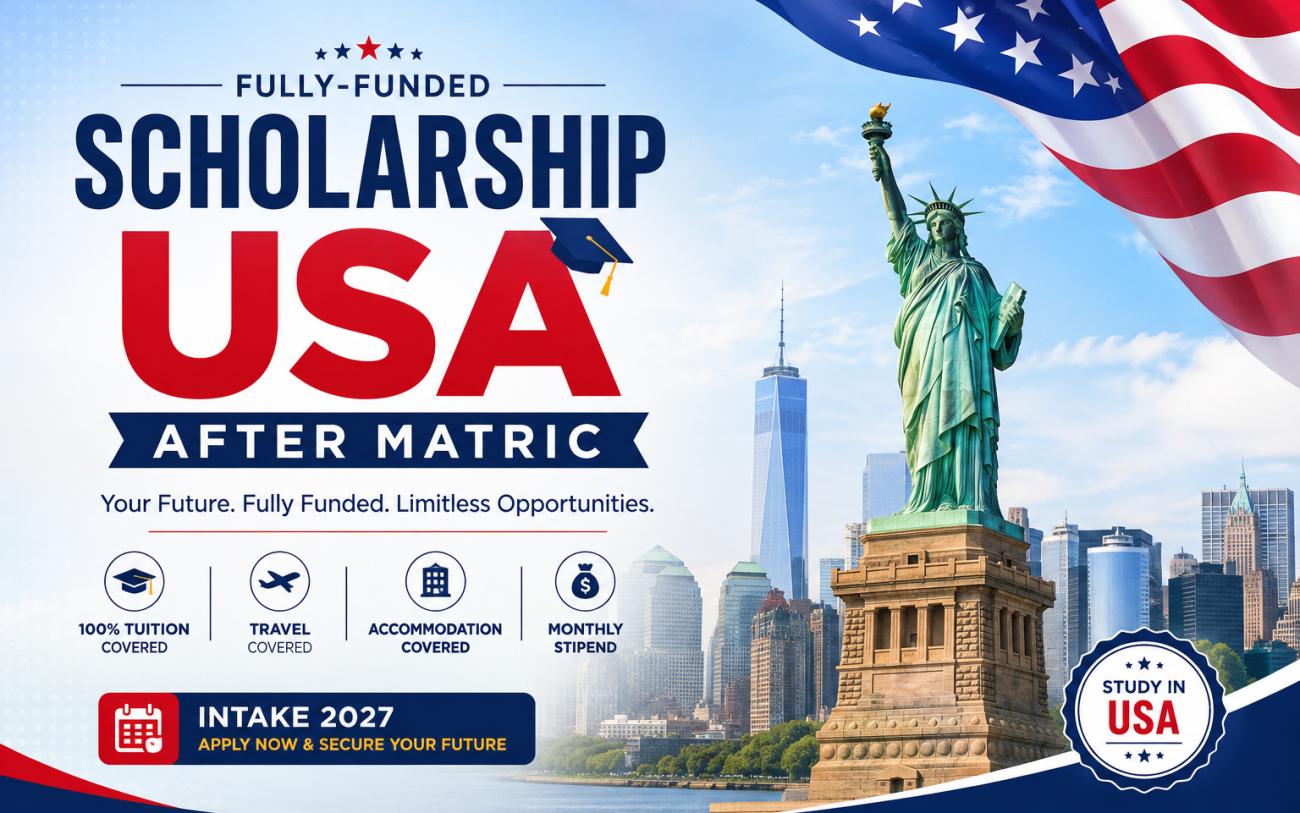
Let’s kill the vague buzzword. A truly fully funded scholarship — sometimes called a full-ride scholarship — covers:
- Tuition fees (the big one)
- Room and board — your bed and your meals
- Books and study materials
- Sometimes even a monthly stipend and your flight home
Where does this money come from? Three places:
University merit scholarships — the school rewards you for being exceptional. Grades, essays, activities, all of it counts.
Need-based financial aid — a small group of elite schools (think Ivy League and top liberal arts colleges) promise to meet 100% of your demonstrated financial need, no matter your background. Learn more about how U.S. financial aid works from the official Federal Student Aid office.
External scholarships — governments, foundations, and organizations fund students independently of any single university. (Fulbright is grad-school only — see the official Fulbright Pakistan program page — but plenty of other programs exist for undergrads.)
Once you understand these three lanes, the whole process stops feeling like a mystery.
Step 1: Start Early — Like, Grade 9 or 10 Early
Here’s the part nobody wants to hear: U.S. universities don’t care that you crushed it in Matric if the four years before it tell a different story. They want consistency, not a last-minute glow-up.
So starting 2–3 years out, quietly build the profile that’ll speak for itself later:
- Take the hardest courses your school offers — A Levels, IB, advanced Matric subjects, whatever pushes you
- Keep your grades steady across the board, not just in your final year
- Go deep, not wide, in extracurriculars — one thing you actually led or built beats five clubs you barely attended
Step 2: Aim at the Right Universities (Best Colleges in USA for International Students)
Here’s a hard truth: not every U.S. university funds international students fully. Some barely fund them at all. So don’t waste your shot applying blind — go where the money actually is. These are widely known as need-blind universities for international students and top picks for anyone hunting a full-ride scholarship in America:
- Harvard, Princeton, Yale, MIT, Stanford
- Amherst College, Williams College, Bowdoin College
- Dartmouth, Columbia, University of Pennsylvania
- University of Chicago, Duke, Vanderbilt
These schools separate “can you get in” from “can you pay” — and many promise to cover 100% of demonstrated need for admitted international students. Always verify a school’s current international aid policy directly on its financial aid page — for example, Harvard’s financial aid for international students or MIT’s international student aid policy — since these policies can change.
Step 3: Nail the SAT, ACT, TOEFL, and IELTS
Boring? Maybe. Non-negotiable? Also yes. Most competitive schools still want:
- SAT or ACT — even test-optional schools reward a strong score. Register directly through the official College Board SAT site or the official ACT site.
- TOEFL or IELTS — proof your English can survive a college lecture (skip if you studied in English-medium). Book through ETS TOEFL or the official IELTS site.
- AP exams — not required everywhere, but they quietly whisper “I can handle this” to admissions officers. Details at AP Central.
Book your test dates early. International slots vanish fast, and you’ll want breathing room to retake if your first shot doesn’t land.
Step 4: Write an Application That Actually Sounds Like You
Admissions officers read thousands of these. The ones that stick are honest, specific, and a little unexpected.
- Your Common App essay — tell one real story, not a highlight reel. Specificity is what makes it memorable. Start at the official Common App site.
- Supplemental essays — show you actually researched the school, not just copy-pasted enthusiasm
- Recommendation letters — pick teachers who know you, not just the ones who gave you your highest grade
- Extracurriculars — depth beats breadth, every time
Step 5: Get the Financial Aid Application Right — This Is Where People Mess Up
If you’re wondering how international students get 100% financial aid in US universities, this is the answer. This step quietly ends more scholarship dreams than weak grades do.
- Fill out the CSS Profile — most schools offering international aid require it, on top of anything school-specific. Apply directly through the official CSS Profile portal.
- Apply for aid at the same time as admission — waiting until later often means the money’s gone, since most schools only guarantee full aid to first-year applicants
- Be completely honest about your family’s finances — aid offices verify, and inconsistencies can cost you everything
Step 6: Don’t Rely on One Basket — Chase External Scholarships Too
University aid is your biggest shot, but it shouldn’t be your only one. Also dig into scholarships for international students that exist outside the university system:
- Government-sponsored study-abroad scholarships back home — check the HEC scholarship portal for Pakistan-specific opportunities
- Foundation or regional programs built specifically for students heading to the U.S. — USEFP’s EducationUSA advising centers are a strong starting point
- Community or corporate scholarships that can fill any remaining gap
More applications, more safety nets, more chances at a fully funded future.
Step 7: Deadlines Are Not a Suggestion
U.S. applications run on strict timelines, so mark these down like your future depends on it (because it kind of does):
- Early Decision/Early Action — around November of your final year. Early Decision is binding, so only go this route if you’re 100% sure this is your dream school and you’re okay committing before comparing aid offers.
- Regular Decision — typically January, with decisions landing in March or April.
Financial aid deadlines usually shadow admission deadlines — track both on the same calendar so nothing slips through.
Step 8: Show Up for the Interview
Some schools offer alumni interviews. Treat it as your moment to be a person, not just a transcript:
- Let your genuine excitement for the school show
- Talk about your goals and how this specific place fits into them
- Ask real questions — about the classes, the campus, the community
Step 9: Stay Organized (Because This Gets Messy Fast)
Juggling multiple schools, each with its own essays, forms, and deadlines, will test your sanity. Build one master tracker for:
- Admission and aid deadlines
- Required documents per school
- Recommendation letter requests and follow-ups
And brace yourself: even brilliant students get rejected. Apply to a balanced mix of 8–12 schools — reach, match, and safety — factoring in both your admission odds and each school’s aid policy.